Pages

Wednesday, September 30, 2015

Madagascar: Lemurs, Lizards and Zebu


Madagascar, sometimes referred to as the “8th continent”, was Liam’s country choice for our around the world journey.  It’s not an easy place to get to, even from the Africa mainland, but we decided to go for it since we were “close” and the unique ecosystems are quickly transforming into farms and factories.  Madagascar is a big country, a little more than 2 times the size of Colorado.  In our 12 days we saw just a small portion—we flew down to the South West coast and worked our way back up to the capital, Antanavarivo  (“Tana”) in the central of the country—the “RN7” route, named for the national road we primarily followed.  The country was incredible and worth the effort to get to.  The people are very friendly even when we could not speak the main languages of Malagasy and French.  Also a welcome surprise was the food was delicious.  It is the first country we have seen baguettes of French bread sold in baskets on the side of the road. 


Ifaty beach dug out canoes
We were fortunate to discover that our in-country flight to the coast switched from 1pm to 7am the day before with no notice from Air Madagascar (the only option for in country flights) -- whose workers have been on strike so flights are sporadic and reservations only confirmed once you’ve arrived at your destination.  Once we arrived, we rode in a pickup truck through the desert on a bumpy sand road (30km = 1.5 hours) to Ifaty beach past mangroves, baobab trees, and octopus shaped succulents over 5m high.  The beachside location was idyllic-- Liam described the setting as a “VIP hotel picture”—we walked through swarms of butterflies to get the aquamarine ocean with sand littered with beautiful shells.  People that live in the village nearby fish out of dugout canoes propelled by colorful patchwork sails. We enjoyed a few days swimming and playing in the sand, collecting shells (most of Liam’s included live hermit crabs, much to Jim’s surprise when he was the repository for Liam’s overflowing handfuls).
Next we headed inland to Isalo National Park - a desert landscape whose silhouette looks like the American Southwest but on closer inspections looks like a Dr. Seuss book-- green lichen covered cliffs and strangely shaped plants with nasty spikes and beautiful flowers.  We went for a hike with a local guide who pointed out almost impossible to see stick bugs and medicinal plants that do everything from removing warts, to healing wounds, to being used like glue.  The cliff face was dotted with Salklalva tombs, marked with Zebu horns (cattle with humps on their backs and big horns) and rock cairns. We also got our first look at ring-tailed lemurs, who gracefully bounce from tree to tree and make sounds like a mix between doves and cats. They are charming. 
Next we headed off the highway on an exciting dirt road to remote Camp Catta in the Andringitra National Park.  On a trip with many impressive “out the window” accommodation views, this was one of the most breathtaking: Families of cooing lemurs with babies clinging to their tummies playing in the trees outside of our bungalow framed by stunning peaks capped in clouds.  There was even a “natural pool” for us to play in after a long hike up to the top of the “chameleon peak”— a challenging (at least for Carolyn) 15km circuit on which we had to step aside for local villagers herding Zebu and/or single handedly carrying huge logs in bare feet. The hike up did send home the lesson learned to make sure to look up and enjoy the view (but be careful what you’re stepping into.)  Our guide showed us how to make a bracelet out of the “string” inside of plants, and we saw cool chameleons, orchids and a huge rainbow-colored grasshopper.
After a bumpy ride (let’s hear it for our driver) back to the RN7 we stopped off at the Anja Reserve, where we scrambled over rocks and through a caves to get to a lemur-filled forest and fed a chameleon a grasshopper on a stick.  It had a shockingly long and fast tongue and even managed to impress Xander.  Our final hiking adventure was in the rainforest in Ranomafana National Park.  On the way there we even saw a 6ft+ tree boa slithering across the road.  Here our guide took us way off trail through the muddy jungle brush to search for lemurs and other elusive creatures.  We saw four different types of lemurs, including the golden Bamboo lemur (this lemur was only discovered in 1986), leaf tailed geckos, chameleons, a giraffe beetle and even a crab (!) living in the water pooled inside of a crevice in a tree.  It seems sometimes you need to get off the beaten path to get to the cool stuff… even if it’s steep, muddy and filled with thorny trees.  

Our last few days up to Tana included driving through an increasingly populated and cultivated landscape.  Smoke was thick in the air for some of way and we passed several spots where we actually could see and feel the flames from a slash and burn site.  Our guide said that there are radio announcements not to burn forests, but it’s hard to promote conservation when people need to live and eat somehow. We got to learn about different types of handicrafts, such as wood sculptures and zebu horn carving, where people create beautiful crafts in ingenious ways - such as using a washing machine motor and old cut up jeans to buff and polish horns.  The capital city Tana is a bustling city with myriad people and narrow streets choked with traffic, road side stalls selling everything from cell phone minutes to chickens (alive, dead and cooked), surrounded by rice patties and made-by-hand brick yards.  The highlight of our time in Tana was spending an evening with new friends Zane and Michael and sons who teach at the international school as “trailing spouses” (which seems much better than being a corporate spouse) for their wives who are Peace Corps directors.  Mexican food never tasted so good!
giraffe beetle
We all enjoyed Madagascar and confirmed that hiking and animal spotting (along with pools at hotels) are some keys to our collective happiness. Madagascar seemed easier than Ethiopia, maybe because of the “Mula Mula” (slowly slowly) attitude of the Malagasies or maybe we are getting better at adjusting to our surroundings and conditions.  Now it’s back to South Africa.  This week we will head up God’s Window and Kruger National Park—but first this weekend we’re going to hang out with some local friends and learn about the two main national pass times—Braai (BBQ) and Rugby. 

Senses:
Jim: The cloud of pink water trailing liam walking through the ocean, thinking it might be his blood, but realizing it's just an "inking" fish off of Ifaty Beach, Madagascar; The sweet sound of a woman singing in the sea gathering crabs and other sea creatures from the shallow tidal flat; the bright green and yellow lichen covering the desert canyon walls at Isalo National Park as I recognize the comparison to the American southwest yet appreciate the differences; the cool (literally and figuratively) cave under the lemur forest used by the lemurs for weekend parties because of the great acoustics;
Xander: the fishing boats with hand-made sails going to the shore as we spotted the small glimmering spotted puffer fish in the grains of the wetted sand; the large tortoise’s starry black shell crashing through the weak twigs to get to the shade underneath the rock; the small baby lemur's tail wrapping around its mother's stomach as his minuscule head turns to reveal his pudgy face; the  golden tail of the  golden bamboo lemur draped on the secondary forests canopy as we squelch down the root and vine-infested hill
Carolyn: The rows of rice fields covered in muddy water, lined by drying laundry on our traffic jam drive from the airport to the Tana city center; the tiny striped tail of the baby ring tailed lemur sprouting out from where it clings to its mother's belly as she gracefully launches from tree to tree; the astounding rainbow colors adorning the back of the giant cricket standing out from the white and grey "elephant foot" plant; the heat and smoke from the fires blazing on the blacked landscape gruesomely demonstrating the conflict between conservation and livelihood.
Liam: holding the displaced but beautiful shell looking inside to see if I can discover a hermit crab; the tall yellow blooming flowers sprouting out of what looked like a miniature spiky baobab tree at the arboretum in Tulear; the bitterly cold water freezing my sensitive skin as I swim vigorously to try to catch the tadpoles on the black pool underneath the waterfall at Isalo national park; the  fuzzy and soft brown bamboo lemur scurrying up the  long bamboo pole as dad frantically tries to get a picture

Lessons Learned:
  • Madagascar has random trampolines
  • Zebus are the cattle with the big hump on their back.  The hump is filled with fat and given as food to elders as a sign of respect
  • People in Ethiopia and Madagascar carry staggering loads on their heads and backs.  Only women carry loads on their heads.
  • Tombs in Madagascar are square piles of bricks adorned with zebu horns to show the wealth of the family.
  • There is a plant that is super bitter that is used to wean babies and stop nail biting
  • Assume that a driving time estimate is at least 50% greater than that provided by the tour operator
  • Where there are palms there is water
  • Zebu are used to save money instead of a bank.   Malagasies sell them when they need extra money.
  • Do not use your fingers to point at tombs, instead curl them down and point with your knuckle
  • There are two types of tombs, temporary used for two years then when the body is bones they are brought back to the village washed and celebrated again then placed in the permanent family tomb
  • There are 18 tribes in Madagascar
  • There is a plant that poisons fish and people just net them when they float to the top.   The poison is not harmful to humans
  • Malagasies dry corn for months in the hay on the top of their houses to get the seeds ready to plant
  • A minivan with a two rows of seats and bucket seats that recline is way more comfortable than a Landover
  • Malagasy people are resourceful-  for example, they reuse wires from tires and strings from chairs to make saws to create intricate woodcrafts

Sunday, September 13, 2015

Ethiopia: Churches, Mountains and Sharing the Road

“Ethiopia is travel, not vacation” – Xander

“Travel opens the mind and loosens the bowels” – Goshe, Cutting for Stone


The misty cool, lush mountains surrounding Addis Ababa that we descended into are nothing like the scorched desert landscape television show images we saw growing up.  We arrived on an overnight flight from Rome on Ethiopian airlines, an airline that still serves full meals, even if it’s 2 in the morning.  After getting our visas and a surprisingly quick trip through customs, we were greeted by the tour group owner and whisked to the Land Rover, where we’d be spending the majority of our time in the country.  After breakfast at a hotel (turns out the kids don’t like Ingria, the ubiquitous sour flatbread that’d made from the grain Teff) we got some Ethopian Birr and headed out of town.  The highest ETB bill is a 100 note (about $5), so we were sporting large rolls of cash throughout the trip.

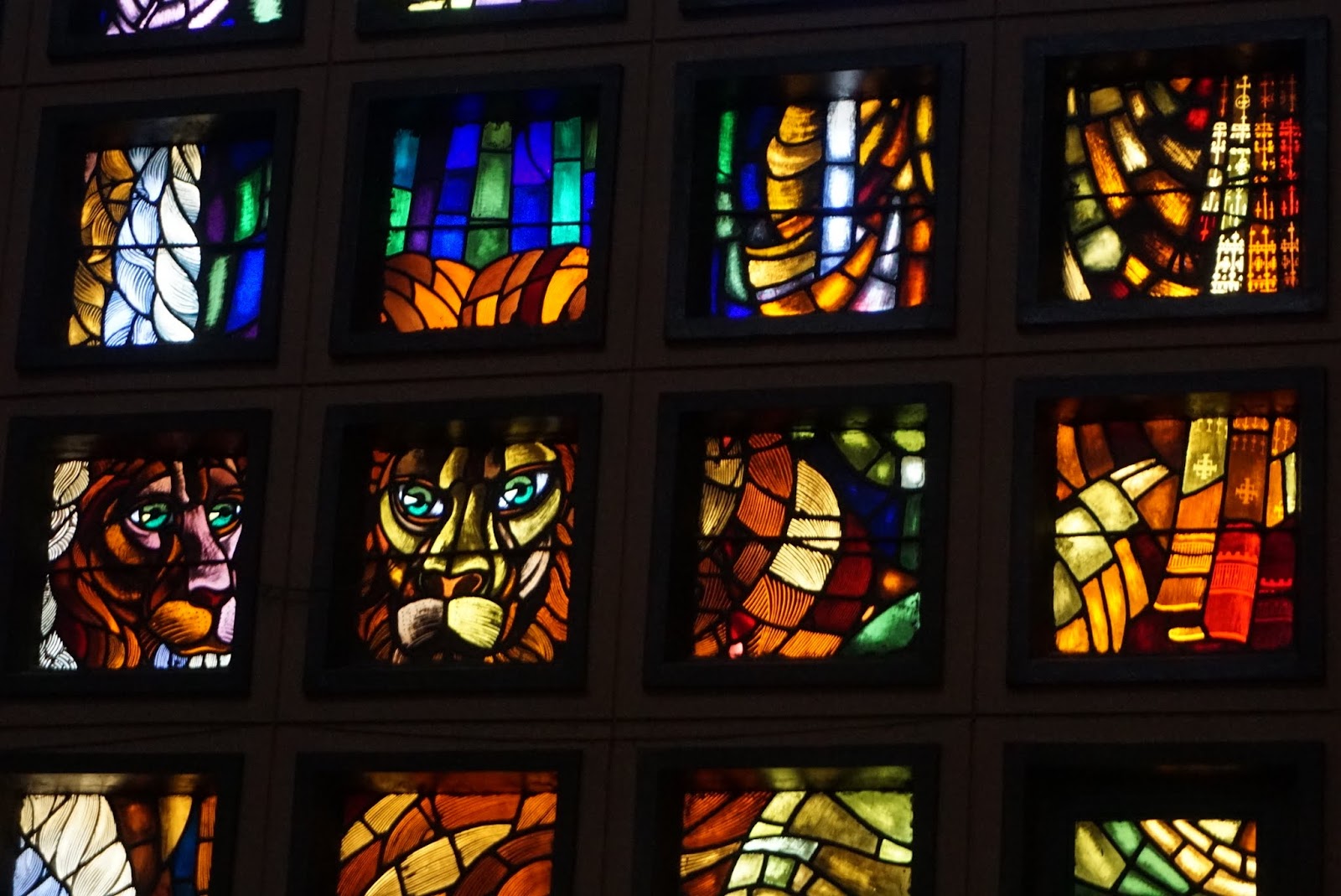
Debre Libanos monastery stained glass
Our first stop was the Debre Libanos monastery, which would turn out to be the first of many Ethiopian Orthodox churches we visited throughout our trip.  For kilometers before we arrived hundreds of people draped in white were walking towards the monastery on a pilgrimage to a celebration of the founding of the monastery that would be held a few days after we visited.    All eyes were on us as the local guide we hired (all churches have an entry fee and a guide fee) took us around.  We were all pretty intimidated because we were out of our element (if ever there was a euphemism), the center of attention and sleepless-- but the stained glass and paintings vividly depicting bible stories were awe inspiring. 
Blue Nile Gorge
The next stop on our 10+ hour drive to Bahir Dar was at the Portuguese Bridge, the “first” (one of several with this claim) bridge in Ethiopia overlooking the stunning Blue Nile Gorge.  Troops of baboons played near us on the rocks and accompanied us on the way to the toilet.  Many of the toilets in Africa (and Asia) are “squat” toilets (i.e. a hole in the ground with footpads), so that added an additional element of adventure and exercise

Ethiopia (at least where we were in the north) is lush and mountainous.  We spent the majority of our time driving through the Northern part of the country.    Although many of the days were butt numbingly long (8+hours) (and surprisingly tiring) having the opportunity to see so much of the landscape and lifestyle was amazing.   
Sharing the road
We definitely needed the Land Rover and the impressive skills of our driver, Asi, to navigate among the people, donkeys, sheep, goats, cattle, camels, mini buses, washed out roads and other hazards throughout our travels.    

At Bahir Dar we took a boat on huge Lake Tana to a peninsula where we visited another monastery and saw the source of the Blue Nile, the source of the majority (85%) of the Nile river that travels north through Egypt.  This region is also the birthplace of coffee, which grows wild throughout the area.  Coffee was discovered when a farmer wanted to figure out what his goats were eating that were making them so frisky.  That night Xander was the first of us to get sick--  Ultimately, Liam, mister “nerves of steel and stomach of iron” was the only one of us who didn’t.  According to our ex-pat friends who live in Addis, it’s inevitable for Americans to have some sort of stomach issues- but it we were very happy when Xander recovered in a few days.

Gonder castles
Axum Stele
The route we traveled took us through the historical centers of Ethiopia—Gonder, Axum and Lalibela.  Gonder was the capital in the 1600 and 1700s and contains Camelot-esque stone castles ruins of successive emperors and bloody battles, including lion cages that were in use until the 1990s.  Axum, a sister city of Denver (there’s a sign for “Denver Street”) is the home of many “stelaes” from the 3rd and 4th century—huge (some are over 100 feet) obelisk granite tombstones (think Washington monument with a curved top) that mark hidden tombs beneath.  Although most of the artifacts from the tombs are long gone, we felt like intrepid explorers as we climbed underground and discovered a bat and a “tomb frog”.  J )   Ethiopians believe Axum is the home to the actual Ark of the Covenant, which is maintained by a monk who cannot leave the small  gated area and dreams of the next monk  who will succeed him.  This belief is so strong that every Ethiopian Orthodox church contains a replica of the Ark.  We also toured a small museum with hundreds of years (and millions of dollars) worth of emperors’ crowns and other treasures displayed in rickety cabinets covered in decades of dust.    Axum is also the site of Balthazar’s tomb (one of the three wise men who attended the birth of Jesus; Balthazar brought Frankincense).  All pretty amazing.
 Incredibly, the stones were carved by hand from the mountains then transported 10-15km by elephant and slaves to mark the tomb sites of the rulers.  When the Italians briefly occupied Ethiopia in the 1930s under Mussolini, they cut one of the biggest steles into 3 pieces and transported it to Rome to put in the Circus Maximus (ironically, the same place we were the day before we came to Ethiopia).  After WWII, Italy had to give the stele back—it took until 2007 to finally get it back and set up properly.  (government bureaucracy and foot dragging at its finest)

Lalibela
Our next stop was Lalibela, probably the most well-known place (at least by people we know) in Ethiopia, containing stunning “rock-hewn” churches carved out of stone from around the 12th century that the Lonely Planet aptly describes as “history and mystery frozen in stone, its soul alive with the rites and awe of Christianity at its most ancient and unbending.”   At one point we had to all hold hands and walk through a pitch black tunnel to get from one church to another (we couldn’t use our phones as flashlights because it was represented going from hell to heaven and apparently there’s no assistive lighting allowed in that transition, symbolic or not).


After the historical tour, we drove down (and by down, I mean 13 hours) to Awash national park where the temperature topped 40C (104F) and we saw the effects of the current regional drought in the empty streambeds and dead cattle along the road.  At the park we saw Ornx, warthogs, Kudu, crocodile and gazelles who are competing with the local tribesmen’s herds of camels, goats and cattle for the sparse vegetation.  Our entry fee to the park included the services of a “scout”—a guy with a rifle that sat on top of the car to hypothetically try to keep livestock out of the park, but mostly to avoid conflict with the tribesmen (who had their own guns).  It’s hard to promote nature conservation when your livestock have nothing to eat.
Awash national park falls


The last few days we made it back to Addis Ababa where we were thrilled to see family, Lisa and Jarod, for a quick 36 hours as part of their whirlwind Africa tour.  We also got to meet up with new friends Sue and the Tyo-Dickerson  family who moved to Addis about 6 weeks ago to work at the international school.  (And people say we’re  adventurous).  With Lisa and Jarod we drove to Sodore hot springs where we had the deep end to ourselves, as the vast majority of people in the pool couldn’t swim and were all piled onto the shallow stairs at one end.  During our short swim, we witnessed multiple rescues and Jarod even made a heroic save of a kid who got stuck underneath the swarm—diving down and hefting him out of the water so the lifeguard could perform CPR (seemingly the wrong way). 

As Liam put it “I enjoyed Ethiopia, but I didn’t really enjoy it.”  It’d hard to come up with the right (or any) words to describe how it was there and how we felt about it.   Memorable, for sure.
Incredible scenery, history and beautiful people.  One of the most striking differences (at least as it appeared to us) was the kids’ lives.  A TED talk we listened about growing up  discussed how in the US before the industrial revolution children were treated as an economic asset—working on the farm or earning money at a factory—as opposed to now, when they are primarily an emotional asset (and an economic liability).  Driving throughout Ethiopia we saw tons of very young (or at least very small) kids sans parents on the side of the road tending livestock or carrying water and/or loads of wood that would impress weightlifters.   No danger of being double booked with soccer practice and piano lessons for these kids.  Xander said that seeing these other kids in different circumstances makes him feel “special and spoiled” and Liam says he feels “privileged and glad” to be him (but he is always glad to be him).  They said they don’t know how some of their friends would survive if their roles were reversed “with no electronics, and just old fashioned sticks.”  Ahh, perspective.
Now we’re in South Africa, coveting the hot water and consistent electricity for a few days of RS&L (relaxing, school and laundry) before heading to Madagascar on Tuesday.  Can’t believe we’ve been gone over two months already!

Notable Senses:
Liam: The blocky multi-shaped stained glass shining dark colors in my eyes as we walk into the smelly monastery and became the center of attention; the camels standing majestically as the beautiful green mountains stretch behind them in the distance; the miniscule frog hiding in the dark gloom of old partially flooded tomb of King Balthazar; the intricate church that was carved by chisel and hammer revealing itself as I walk down the stairs at Lalibela; hurricane speed winds forcing the door inward as I jump under the bed in fright

Carolyn: Watching a family of baboons scamper over the Portuguese Bridge getting misted by the thundering waterfall cascading into the Blue Nile gorge; the smell of frankincense wafting through the circular monastery as we learn about bible stories from the vibrantly colored paintings covering the inner walls; the bright yellow of the eggs from Xander's breakfast splattered on the ground as I helplessly watch him throwing up on his hands and knees on the side of the road; the small children herding cattle and goats on the side of the road shimmying their shoulders in hopes that we'll throw them an empty water bottle out the window; the feel of the uneven rocks under my toes as I listen to the chanting and chimes reverberating off the chiseled stone of the Lalibela church

Jim: Wandering through the rain forest full of wild coffee and being surprised by a white bearded monkey near the Lake Tana monastery; amazement as we travel down the cliff face of the gorge surrounded by beautiful clean waterfalls kilometers away from towns to see small kids collecting rocks to sell for construction; the magical energy climbing into the muddy mound which opens to the tomb of Balthazar the Wiseman who followed the star to the birth of Christ; the sweet joy of the restaurant being out of avocado juice and offering fresh squeezed mango juice as an alternative.   Delicious.

Xander: The hundreds of dark eyes watching our pale skin as we walk through the dimly lit monastery the day before founder's day; the hornbill cackling its devilish laugh as the fish in the 3000km2 Lake Tana lazily jump out of the water; each twisting turn revealing a spectacular view of the mountains and the bizarre sight of camels during long drive to Lalibela; The wind howling through the hallway and pushing the bird backwards, bringing in a thunderous storm that warped the glass balcony door; the scalding hot water singing my pale feet into a deep pink hue while I avoid the splashes of locals and gingerly tiptoe through the soldore hot springs showers

Lessons Learned:
  • Ethiopia has 90 million people and is the most populous land-locked country in the world
  • Addis Ababa (2300m/7500ft) is at a higher elevation than Denver
  • Until recently all of the Ethiopian "popes" were from Egypt
  • Women typically wear skirts and cover their heads
  • Ethiopian orthodox churches are in three parts.  Men and women worship on different sides and the churches are typically circular.
  • Some baboons in Ethiopia have a red hour glass chest and long flowy hair.  They aren't aggressive.
  • Angria (spongy sour flatbread) is made from Teff, a grain that’s gluten free so it will probably be all the rage in the US soon
  • In Ethiopia, when you shake hands you bump shoulders 
  • Honey is not always clear (especially if it still contains the honeycomb)
  • The amount of space you take up is proportional to  your size. For example Liam takes up the most room in the car,  Xander takes up the most room in a bed.
  • Power goes out frequently in Ethiopia  (often for several hours a day). Running water can be hit or miss as well. 
  • There is a connection between the treasures at axum in their prime and Ravenna Italy.   There was an Italian carved irovy tusk found at the site.
  • If you hit an animal while driving you need to buy a new one.   Goats range from 200-1000 birr, horse 2000 birr, camel 10000 birr.  If you hit a female animal you need to pay more because it could’ve had babies.
  • The Ethiopian alphabet has 32 letters and looks like people dancing
  • Camels are used for transport in the north and food and transport in other areas of the country
  • In the far north of the country (near Axum) there are refugee camps for people from Eritrea (the country to the North of Ethiopia)
  • Lions were kept in cages at Gondor until 1991
  • Ethiopian Orthodox Christians have over 260 fasting days
  • In Ethiopia “Chinese are like oxygen—they’re everywhere”
  • Rastafarians in Jamaica worship Haile Selassie, the emperor of Ethiopia  who ruled from 1930–1974 There is a statue of Bob Marley in the middle of a traffic square in Addis Ababa 

Thursday, August 27, 2015

Europe Part 2: Cathedrals, Waterfalls and Limestone

A disclaimer:  Because we waited too long to post this, there’s a lot to tell you.  We considered just keeping it short and sweet, but got a request to go ahead and write about everything (blame Tracey).  If long blogs bore you, please skip to the senses and lessons learned :)


For the past few weeks we traveled from Switzerland down to the Adriatic coast via Milan and Ravenna, took the ferry over to Split, Croatia, and then traveled up through Croatia into Slovenia and back down through Italy through Venice and Florence to Rome. 

Switzerland to Italy
The trip into Italy from Switzerland was a stunning one through Swiss tunnels and impressive switchbacks where motorcycles zipped by us on blind curves at angles closer to the ground than vertical.  Apparently, all of Europe goes on holiday in August leaving on Saturday and one of the tunnels was closed—we passed kilometers of stopped traffic that makes I-70 ski traffic on a Sunday afternoon look like a cake walk.  

Milan Duomo
We’d been lucky with the weather and hadn’t had to deal with much heat, much to Xander’s delight, but the heat caught up with us in Italy, which we encountered for the first time when Carolyn led everyone astray in Lake Como walking up the wrong hill to try to visit a beautiful villa, that, once we finally found, ended up being pretty boring.  I guess you can’t win them all—and at least Jim got practice driving through streets so narrow he had to fold in the mirrors. 
Ravenna Mosaics  
Our travels took us  near Milan to a surprisingly nice hotel where Liam learned that the “sink for short people” is actually a bidet—these kids are getting so cultured J Driving across Italy we stopped at the Milan and Ravenna Duomos, where we got to see incredible architecture, stained glass and mosaics.  Even as religious and art illiterate as we are, we were all in awe of these incredible buildings. 

 Next we stayed in the small Italian hill town of Petritoli, where Rotary friends from Denver, Carolyn and Paulo, were incredible hosts and shared their amazing 4 story villa with us.  It was wonderful to explore the area with “locals” from home.  Below is a poem that Liam wrote about our rejuvenating time there:

Oh my the sky as I lie on the chair
Enjoying the Italian Hill Country with Carolyn and Paul
In which nothing can compare
To the refreshing air
Or the grassy farm filled hills
With a couple of scattered mills
Which will me to a thrill.
The coast of Italy not so far
In this pleasant castle terrace
Atop a towering castle wall.
The stracciatelli feeling good
In my belly as I look at the
White walls of the secret church
Inside the town of Petritoli.
Now I have to say goodbye
To playing Shanghai
With a super nice guy
And the beautiful blue sky.

Our adventure continued with new type of accommodation-- the overnight ferry from Italy to Croatia.  We had no idea what to expect of our “economy berth,” but it turned out to be good with air conditioning which was key - given how hot it was (33 C).  We were happy not to be one of the passengers sleeping on the deck; worth our extra 20 Euros for sure!  Split is a dynamic port city with soviet-style blocky apartments and the amazing Diocletian’s Palace complex.  We beat the crazy heat taking a dip in the Adriatic sea- along with swarms of vacationing Europeans. After our quick trip to Split we headed north because we opted to go to national parks over going south and visiting Dubrovnik.  It’s surprising how many “don’t miss” places and things we need to skip even with all this time.
Swimming at Krka National Park
Both Krka National Park and Plitvice Lakes National Parks were amazing, despite the heat and crowds.  In Europe, each car’s license plate has a country letter, like the state plates in the US- so we could confirm that the variety of people and languages came from places ranging from D, B and NL (Germany, Belgium and Netherlands) to PL and SLO (Poland and Slovenia).  Of course, people continue to think we’re from France because of our trusty just off-the-line Peugeot, so you never really know. The water color and clarity in the lakes, rivers, and waterfalls is otherworldly (and also good for a chemistry lesson).


Jim's happy place
Next, we headed north to Slovenia (not to be confused a la George W Bush with Slovakia, which is 2 counties to the north) not knowing what to expect, but left understanding why LOVE is in the county name.  This country, which was created in 1991 as part of the collapse of the Soviet Union, has a statue of a poet instead of a war general in Ljubljana’s (the capital city’s) main square.  We stayed at a guest house outside of charming Lake Bled.  We’ve been pretty insular, so it was a highlight for all of us to get to know  other guests from Israel, Austria and the UK over our several dinners together. Turns out “Spot It” is an awesome game for kids in any language.  In Slovenia, we paddle boarded above giant carp, took an alpine slide, awkwardly paddled a defective row boat in the rain, rafted on emerald waters, walked above the biggest underground ravine in Europe and Jim (finally!) was able to fly fish.   The water was so clear you could see the trout and grayling from about 400 feet above the river.  

Dreaming of Gladiators
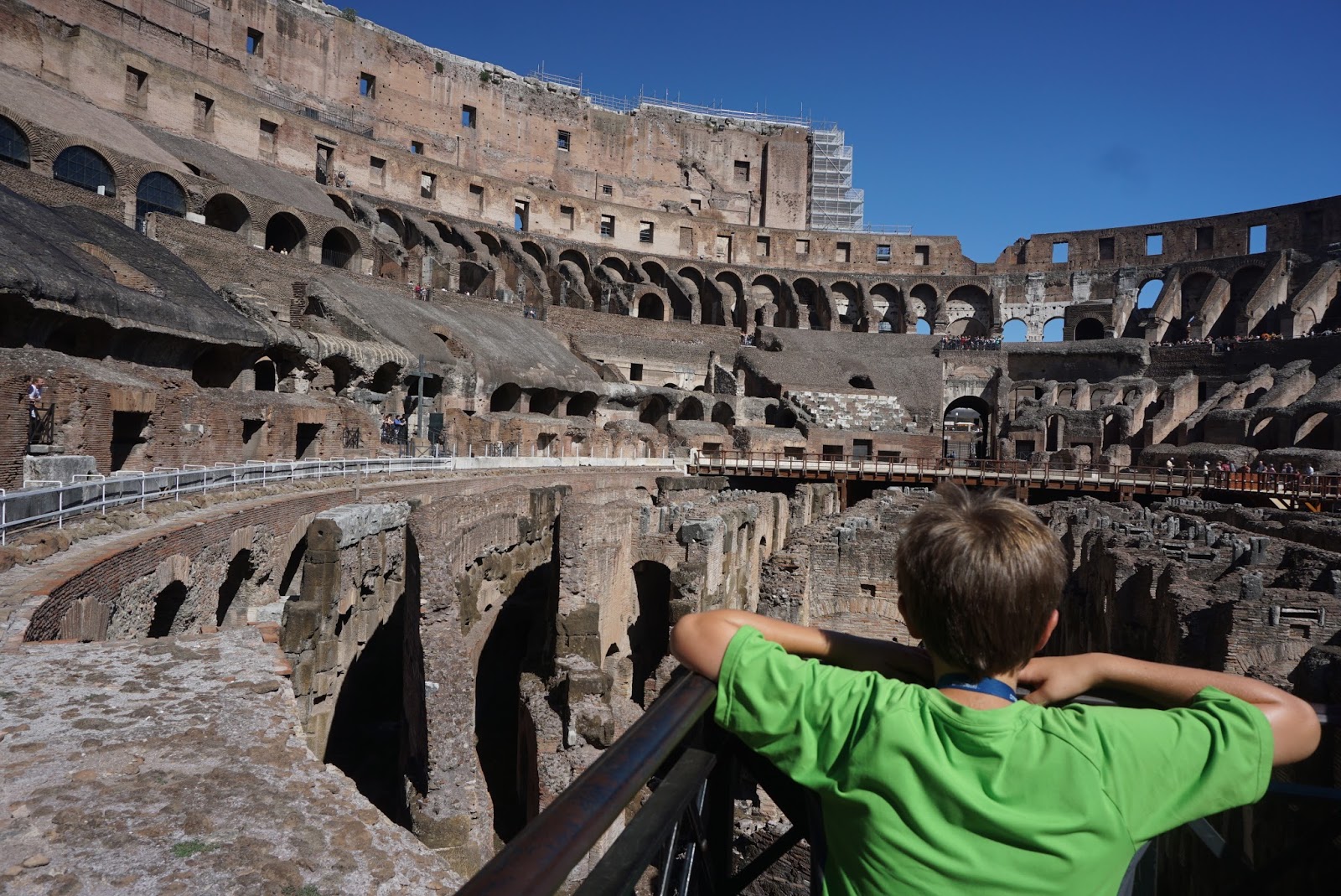
Finally, we headed back around to Italy and had several quick day trips in Venice, Florence and Rome.  Liam loved the glass animals in Venice (probably the best thing ever to carry around the world in a backpack), we all thought the Galileo Science museum in Florence was really cool and Rome, well, who doesn’t like envisioning 100 lions appearing to fight gladiators while gazing at maze underneath what was the Coliseum floor?

It’s hard to believe that tomorrow we leave our first continent (and our beloved car) to travel to Ethiopia. We’re excited and a little queasy (but that’s probably from the Malaria medicine…)
Cradle of humanity, here we come.

Senses:                                             
Carolyn: The marble buttresses and statue-topped spires criss crossing the Milan skyline from the terrace on top of the Duomo Cathedral; The juxtaposition of intricate mosaics and detailed fresco paintings on the high ceilings of the Ravenna Basilica; the bubbling waterfalls cascading under my feet on the boardwalk wandering through Plitvice national park as I marvel at the fish that look like they're floating in air underneath the crystal clear water; looking for Indiana Jones or Golumn to scale down the tenuous  explorer path cut into the cliff side on the enormous cavern of the underground ravine
Liam: The beautiful scenery of the grassy farmland hills as I won Shanghai card game against Xander; the force of the powerful white rapid waterfall as it tried to pull of my swimsuit as I struggled to hang on the rope at the bottom of the Kvar waterfall; the magnificent scene of the Julian Alps as we drove on the dizzying 54 switchback road to rafting; The waterfall and river rumbling beneath my feet in the massive cave that looks like it was made by aliens
Xander: The horrible heat disappearing as I dunk my head into the clear turquoise water of the Adriatic sea to discover fish lurking at the bottom; The rain pounding down on me as I paddle the boat off the oar rails trying to get to the church on the island in the middle of Lake Bled; The drip of the stalactite piercing me in the head as I look at the 200,000 year old stalagmite named giant in the Skocjan caves
Jim: The haunting glow of the thin cut marble windows in the Ravenna basilica; the wispy clouds over the gorge as I catch a rainbow trout I targeted in the perfectly clear Sava Bohinjka; The amazing display at the Galileo Museum on how they constructed and drew wooden globes in the 15th century; Amazement of the expansive collection of Egyptian, Greek, and Roman artifacts "gathered" under the direction of various Popes

Lessons Learned:
·       The Milan Duomo is the only white marble gothic church in Europe
·       Gothic architecture is cool because of the spires and arches where everything meets together
·       Make sure ice cream is stable before you lick it on a hot day or you will lose it.
·       Switzerland has a one-time 40 CF toll sticker vs  Italy, which has a lot of tool booths.
·       If people are stopped on the highway for a closed tunnel, take the pass around
·       Rocky beaches are great because you don't get sand anywhere
·       Diocletian was the last roman emperor to persecute Christians
·       Even an uncrowded Croatian beach is pretty crowded
·       The overnight ferry is a great way to get from Italy to Croatia as long as you're not sleeping on the deck
·       Above 30C is hot!
·       Ljubljana has a statue of a poet in the main square instead of a war general
·       They eat horse meat in Slovenia
·       Toilets in Europe have 2 buttons depending on the number you go
·       You have to put the key in the slot to get the electricity to work in many European hotel rooms
·       What you think is flavored cream cheese may be spreadable tuna fish
·       Sun reflecting off the white limestone helps to make the emerald color of the Soca river
·       River valleys are V shaped, and glacial valleys are U shaped
·       You need a vignette sticker to drive on toll roads in Slovenia (15 euros for a week)
·       College is free in Austria and Slovenia, as long as you don't take too long (average is 7.5 years)
·       Slovenia became a country in 1991
·       In Israel, lunch is the main meal of the day
·       It snows in Jerusalem
·       Slovenia had a similar economic crisis as Greece, but It's so small it didn’t really matter (two million people and about 6% the physical size of Colorado)
·       Slovenian flag has the coat of arms, (mountains, river, stars) although they were considering a pink elephant design
·       Plichnich designed most of Ljubljana, including the dragon bridges, library, university and main square.  He really liked columns.
·       Fly fishing is reasonably affordable in Slovenia (90 euro for a 3 day license)
·       Several of the 54 switchback on Vsric pass have cobblestone to increase the traction
·       Campers are pulled by all types of cars (not just big trucks)
·       Hemmingway drove an ambulance in the Soca Valley in WWI that inspired a farewell to arms
·       The Orient Express went through Slovenia on the path between Paris and Istanbul
·       They currently only have nighttime mosquitos in Austria
·       Look up and around, even if you're trudging straight up a hill
·       Horses are big business
·       Lipija horses train for 5 years to perform dressage and the “bad” horses are worth about 200,000 Euros
·       Stalagmite dripstones grow 1cm every 50 - 150 years
·       The human fish lives for 150 years and eats once every 10 years.  It has no eyes or ears, is white and snakelike, with hands and feet
·       Science used to be used as a party trick
·       Water can be moved uphill using a water screw
·       They didn’t know how to precisely determine longitude until the late 1700s
·       The gladiators and wild animals were housed in the maze like structure under the floor of the coliseum.  They used to get there through tunnels
·       Romans destroyed rome by taking all of the marble, etc from the palaces and temples to build other buildings in the city center (like St. Mark’s Cathedral)
·       The Pantheon still has the largest freestanding concrete dome in the world
·       Emperors of Rome were worshipped as gods after they died
·       It took until the industrial revolution to match the technology in ancient Rome

Thursday, August 13, 2015

Europe Part 1: Canals, Castles & Cascades

(Click to link to highlight album)

The past few weeks we traveled from the canals of Amsterdam and Belgium, through the Germany countryside to the Swiss Alps.  We had a few days when we were in three countries in 4 hours, which is pretty incredible coming from a state that is hard to get out of in the same amount of time. 
The crazy streets of Amsterdam with their hundreds of thousands of bikes and tram and bus traffic coming from all directions were a big change from the relaxing beaches of Texel—Xander was especially unenthusiastic about the crowds and cigarette smoke—but we managed to have fun none the less.  Between a fascinating city tour that included the red light district, the NEMO Science Center that had a teen exhibit with explicitly positioned wooden models, and the just like Denver smell of marijuana drifting out of the coffee houses, we figure we’ve covered much of Liam’s “growing and changing” unit for this year.  Yay “world school”!  However, art appreciation was a bit of a bust as Liam decided he’s “done with museums with paintings in them" after 2 hours in the Rijksmuseum.
We agreed with all of the guidebooks that Bruges, Belgium is a charming city with its scenic canals, cobblestone alleyways and delicious chocolate. Did we mention the chocolate?  No, just ask Liam—He mentioned wanting to get some every 5 minutes for two days (for good reason :) ).  That kid is not wanting in the persistence department.   We saw our first castle, Castle Gravenstein, on a rainy blustery day in Ghent, Belgium, complete with an art exhibit on death and a display of instruments of torture.  Bwahaha.  (Seriously, part of the art exhibit was a blue-lit dungeon with spooky music.) As Xander noted “Don't get people angry during medieval times, you'll probably get tortured and killed.”  We took a wonderful detour up to Breda, Netherlands to meet friends of friends, Jollette and her fantastic family - They took us out to a great meal and ordered off the menu for us (we typically buy food at grocery stores because we know what we’re buying and it’s MUCH cheaper).  It was great to get a little snapshot of living in the Netherlands vs our mostly tourist view.  
Next we made our way down through the German countryside, exploring castles and marveling at the eye popping funicular rides and stunning tall trees in the Black Forest.  We shared a good meal and Hefe-weisen with Britta, Andrea and Justine from the Carolyn’s work Frankfurt office.  Another highlight for Germany was an exciting day at Europa Park-  a cross between six flags and Disney.  We are at the short-lived phase where the whole family is at the same ride “level.”  Although no one would go on the Silver Star roller coaster with Carolyn (minimum age, 11.)  
Finally, we spent a week at a Swiss Chalet (e.g., fairly rustic cabin with no wireless- oh the horror!) in Stechelberg, Switzerland in the Lauterbrunnen glacial valley.   The valley is surrounded by glacier mountain peaks like Jungfrau and Eiger and plummeting waterfalls hundreds of feet long that have carved caves into the granite.  We spent our time alternatively hiking, zip lining, taking cable cars and “trotti” scooter bikes up and down the shockingly steep cliff side wanderwegs (trails).  The first night we were there, August 1st, was Swiss National day inspired by the Federal Charter of 1291 celebrated with yodelers, alpenhorns and kids parading with fire lit torches.  (Switzerland clearly has a longer history and less safety-obsessed parents than the US.)
Bro Wanderin'

We spend a lot of our time figuring out what to do/see/where to go next.  We average about 2-3 days ahead.  We are working on balancing flexibility and stability and trying to fit everything in without burning out.  But things work out.  For example, we somewhat inadvertently missed going to Cologne and the must-see Rhine river valley, but ended up in an Air B&B oasis in Schmitten, Germany, storming castles and getting shot around a not-so-lazy river by jets at a local spa.  We were also annoyed that we booked a non-refundable hotel for 2 nights on the wrong side of town from where we were planning to go, but it turned out to be great and we were able to walk to the incredible Strasburg cathedral in France.  It’s who you’re with, not where you are, right?   Of course, as Xander pointed out, “You will always eventually get sick of somebody.”  Luckily, food and sleep and some lonely time are easy resets.
Favorite senses from the past few weeks:
Liam: The sharp pain of my skin squealing against the wood and screw at the log park outside of the Rijksmuseum, Amsterdam; the intricate look of the huge bells and wires after I was winded climbing up in the 300 steps at the belfry tower in Bruges, Belgium; walking on top of the dance floor on the truly amazing colossal 55,000 gallon barrel of wine underneath the Heidelberg castle; the powerful and humbling sight of the beautiful Strasburg cathedral as I stared at its magnificent stained glass windows
Xander: The dim, spacious annex reveals itself as I climb through the hidden doorway behind the bookcase at the Anne Frank house; the smooth cool texture of the metal chains as I swing with them to victory over dad (twice) on the mini rope course playground in the Hessenpark, Germany; wind blowing across my face at the top of the Baden Baden tower as I look down over the green Black Forest mountains and the swift floating paraglider; the bright blue sky hovering above the clouds climbing the glacier above the Lauterbrunnen valley
Carolyn: The humbling sight of the pictures Anne Frank pasted to the wall in her secret annex house; the silky feel and exquisite taste of Belgium chocolate melting in my mouth at the chocolate museum in Bruges, Belgium; the toe tapping sound of the fiddler and his band playing in the busy courtyard in front of the awe-inspiring Strasburg cathedral; the flashes of hundreds of mini firework explosions whose sound reverberates down the sheer mountain valley long after they finish
Jim: The whoosh of sports cars zooming by at twice my speed as I drive the speed limit on the German highway; the dizzying climb up the worn stairs overlooking the gargoyles and flying buttresses, Strasbourg Cathedral; The smell of alpine plants and flowers as we hike through the forest to the top of the glacial cliffs to the small town of Gimmelwald.


(A lot) of lessons learned:
* If you feel like you're not carrying enough stuff, you're not and you've probably left something behind
* You need to check in and out of trams in Amsterdam
* Red lights were the original botox
* Amsterdam was like the Amazon.com of the 1600s
* Amsterdam buildings have hooks so that people can pully up large items that can't fit up the staircase.  This often ends up breaking windows
* Anne Frank lived in the secret Annex for 2 years
* Rembrandt painted "The night's watch" in 1642?  It is famous for showing the action of the guardsman and his use of light.  In 1975 someone slashed the picture with a knife, but they mostly fixed it.
* There are no moose on art that we could find in the Rijksmuseum
* There are parrots flying around the Voldenpark in Amsterdam
* Don't walk on red paths (bikes!)—especially when you think you’ve finished getting across the street but there’s still a bike path to cross
* People who drive BMWs are jerks everywhere
* If there is a chocolate museum go, because you get free samples
* Bells work like music boxes/clocks and use a lot of gears
* Milk chocolate wasn't created until 1887
* Find the green spots on the map for breaks 
* Never underestimate the size of a place by the front door
* Xander sneezes at least 10 times every morning
* Dutch people are the tallest people in the world
* Seeing local friends is always worth the detour
* The Roman Empire spread all the way to near Frankfurt Germany
* Test out a hotel safe without valuables in it before you lock everything in and can't open it back up
* German rabbit are really fat
* It's a lot easier to keep track of your money if you keep track of your money as you spend it
* Sometimes it's good to spend an extra day
* German pigs are much bigger than expected
* Castle ruins are great places for hide and seek
* What you think is steak may actually be pork
* Wasps love to torment Liam
* Castles were used as rock quarries during the 1700 and 1800s 
* Funiculars are diagonal trams that go straight up a hill
* It's fun to storm castles
* The most efficient path is not always the best path
* European hotel breakfasts are way better than in the US
* Take advantage of a WC (i.e. bathroom) if you’re near one
* People in Germany speak less English than in the Netherlands
* Carolyn is guaranteed to get drenched on water rides
* There are no water fountains in European amusement parks; there are, however, many cigarette vending machines
* Bring a raincoat if you think you're going to go on a water ride
* The Swiss alps has an extensive and expensive system of cable cars
* Switzerland isn’t in the EU.  They use Swiss Francs instead of Euros.  You don’t need to show your passport to get into the country.  However, you do need to have a highway toll sticker on your car.  (Thanks to Jollette for helping us get one back in Breda!)
* There are concrete avalanche bunkers all across the Lauterbrunnen valley
* Hiking trails are called Wanderwegs in German
* Side trips are often worth it
* Sometimes it's good to ditch the tour
* Switzerland is steep (in both elevation and price)
* Swiss hiking estimate times are ways shorter than American hiking estimate times
* Cheese fondue is yummy and easy to make (and way cheaper than at a restaurant)
* The only thing to be afraid of for a 85 kph/800m zipline in the Swiss alps is the anticipation waiting for an hour in line beforehand

We're currently in Split, Croatia after a fun few days in Italy (thank you to Carolyn and Paul for an amazing respite in the beautiful Italian hill town of Petritoli-)We're heading to Plitvicka National Park tomorrow, up through Slovenia, then back down through Italy via Venice and Florence en route to Rome.  If you know anyone in any of those places that would like to meet up, please let us know!

We love your comments-- please keep them coming :)


Saturday, August 1, 2015

A Picture is Worth...


When you can't speak the language, one thing you pay attention to a lot more are the signs.
As one of the the things he's "collecting" (along with rocks, which is great if all you have is a backpack) is pictures of interesting signs he see's along the way, and coming up with his own interpretations of meanings. (Please suggest alternatives!)

Here's installment #1: (Click on the picture below to go to the photo album)


Signs of the Liam

Friday, July 24, 2015

Texel, Netherlands: Sand, Shells and (more) Sheep


After an on-the-go trip through the natural wonderland of Iceland we flew to Amsterdam.  Based on the recommendation of several European friends we headed up north to the beach island of Texel.  First, we picked up our brand new Peugeot 2008—a “European urban SUV” that we were afraid would be the size of a smart car but is actually pretty roomy.  In his months of preparation, Jim discovered a deal where for less than a price of a car rental you can lease a car straight from the maker so that the real buyer can pay reduced VAT tax (which is 20%).  Ah, the French.  Anyway, we have a great car for our 7 weeks in Europe. 
Texel is an island in the Wadden Sea (a UNESCO world heritage site) characterized by a really long beach, sheep (that are taller than those in Iceland), sand dunes, farmlands, and mudflats.  When the tide goes out you can walk to the next island if you know what you’re doing, which we don’t.  We spent our time trying to catch crabs, biking across the island (no one wears helmets, much to the kids’ amazement), walking through the dunes and playing in the sand.  Switching to unscripted days where we weren’t rushing to the next thing is a surprisingly hard change from our typical non-stop life at home; it's also pretty wonderful.

Our most memorable “senses” from Texel include:
Carolyn: The squishy slipperiness of mud oozing around my shoes walking through the mud flats
Liam: The sting of getting pelted by millions and millions of sand grains and shells in the 24mph wind on the beach
Jim: The taste of Texel in the meats, cheeses, bread, eggs and beer all made from the farms around the island.
Xander: The thunder of the retreating waves as the grainy sand in my hands piles up to make another wall

Lessons learned:

  • Texel is the only place where a navy was defeated on horseback.  The Dutch navy froze into the ice around Texel in 1795, so 128 French army men rode up to it and demanded surrender. No shots were fired.
  • Our new Peugeot car engine turns off at stoplights, and that's ok.
  • Have enough cash to cover whatever you're buying (credit cards don't seem to be accepted everywhere in the Netherlands). If you don’t, you must rely on the kindness of restaurant owners who let you come back later to pay (without having to leave a kid for collateral) and grocery store workers who let you in to use the ATM after they are closed.
  • Cool trick to convert Celsius to Fahrenheit: double the number, subtract the 10s number from the result, and add 32 (e.g., 23C = 23*2 = 46 - 4= 42 +32 = 74).  It is easier than F = 9/5*C +32.

  • If Liam looks at you like he loves you and gives you a hug, he wants some M&Ms
  • Baby crabs live in seaweed

  • If you try to jump over a river, commit or you will end up with wet shoes

  • Crabs turn into balls when they fight

  • Tides have approximately 6 hour cycle (each way)

  • Build sand castles when the tide is going out-- the castles can be much more elaborate
  • People in the Netherlands put sprinkles on bread and butter.  Dark chocolate sprinkles are the best (milk chocolate is too sweet)
  • Tweenager boys are gassy, and don't care who knows it
We just spent a few days in Amsterdam, are in Belgium, and are heading to Germany tomorrow (more details later).  Central Europe here we come!

p.s. we’ve been updating the facebook group “CoWanderers” with pictures more often than the blog. Please join if you’re interested!