Pages

Tuesday, March 8, 2016

Australia Part 1: Beaches, Wildlife and Warnings

That which does not kill you… does not live in Australia.

Click here for Australia Part 1 Photo Highlights  

The Australians we’ve met (who have all been friendly, funny and welcoming) have been keen (and sometimes delighted) to regale us with warnings about the many lethal dangers of this incredible country.  Conversation with hotel manager:  Me: “Can we swim at the beach?” (wondering the water was too cold)  Him: “Oh yes, we haven’t seen a shark in a few days”  (actually he said “all summer” but still).   Dangers include not only Sharks, Snakes, Crocodiles, Spiders and Rip Tides, but also:
·       Jellyfish:  The box jellyfish is the most venomous creature in the world.  A marine biologist who was teaching us about the reef said that a sting from one of these will cause the most horrible pain imaginable, but only for 60 seconds because that’s how long it takes its toxins to kill you.
·       Birds:  Colorful Cassowary birds (described as “Emus in drag”) can disembowel with their raptor-like toenails.
·       Snails: innocent looking cone snails have a tooth (a tooth!) that can shoot out like a harpoon, impale your foot and shoot you full of neurotoxins.
·       Trees:  Some trees have seeds so large they can drop on your head and kill you.  We thought they were kidding about this one until we saw a foot+ sized pinecone.
·       Drop bears:  You may think koalas are cute and cuddly… (you may catch one of these on snipe hunt ;) )   
Grand Pacific Drive to Wollongong
That’s not even counting the many other things that can bite or sting you and cause excruciating pain.  This all compared to New Zealand, where the biggest threat is driving on the other side of the road (which they have in Australia as well).  I guess that’s why stuff like bungee jumping was invented in New Zealand—they needed to increase the country’s fear factor.  In any event, Australia is awesome, even if we’re trying not to touch anything. 


We started out in south of Sydney in Cronulla, staying with awesome friends of friends where we tasted kangaroo meat and got to explore the bays and cliffs around the coast that are covered with stunning houses that have “inclinators” (used to get to the water) that  look like roller coaster tracks plummeting down to their same-colored boat houses. In the Royal National Park the kids jumped off a 10m+ high cliff at Watamolla.  Why am I more afraid of heights for them than I am for me?  

Next, we headed down South on the gorgeous “Grand Pacific Drive” along the coast where the winding road is built out over the sea to protect against cliff landslides.  In Wollongong we had a wonderful stay  with the hospitable Murphy family. Xander and Liam don’t get the opportunity to hang out with too many other kids, so they reveled in the opportunity to play WWE on the play station and boogie board with 10-year-old Antony.
3 sisters and 2 goofballs, blue mountains


On the Great Ocean Road
We drove down to the Shoalhaven zoo, where we met some of Australia’s ool indigenous animals, including wombats, cockatoos and koalas.  The craziest thing about that zoo is that it had “adventure walks” where you could scramble up and down rickety ladders and over boulders into bat caves, flinching anytime you brush against anything tickley because it most certainly is something creepy crawly that could kill or maim you.  Great fun.  (actually it was) We hiked in the Minnamura rainforest, home of beautiful lyre birds, that can mimic anything they hear--  the one we saw sounded like R2D2.  I guess it saw the new Star Wars movie.  Based on local recommendations, we went to the Jambaroo Water Park (“where you control the action”), water rides are named after some of Australia’s more notorious deadly creatures (Funnel Web, Tiapan) and signs warn “Sharks have been spotted in this pool.  They come out when they smell pee.”
Enjoying the rain at the 12 Apostles
From Wollongong we headed north west to the Blue Mountains, which get their name from the blue haze from the eucalyptus trees.  Here we enjoyed the steepest railway in the world (complete with Indiana Jones music and seats on which you could adjust the angle from “laid back” to “cliffhanger”) and a relaxing day at a great guest house where we were visited by cackling kookaburras, cheeky yellow cockatoos and brightly colored rosetta birds.
Adventures near Melbourne

Next we flew down to Melbourne on the southern coast of the country, where we tested out our boomerang throwing skills at the aboriginal center and drove along Great Ocean Road to the “12 Apostles” on a rainy day where violent waves emphasized why now there are only 6 rocky pinnacles.  We went on a surprisingly successful wild koala hunt where we spotted several of these fuzzy balls of fur swaying high in the eucalyptus trees.  Koalas sleep 20 hours a day and are high pretty much all the time they’re awake from the eucalyptus.  What a life. 

Squeaky beach, Wilsons Prom
We made our way back up to Melbourne and enjoyed the Melbourne museum before spending some days with the awesome Nolan family, who had stayed with us in Colorado several years ago.  Yeah travel karma.  Great to catch up and laugh about culture differences—why do we call a toilet a “restroom” and how could anyone be excited to see squirrels?  We even got to see wild kangaroos-  which seems to akin to seeing deer, but still pretty cool for us.  In our last adventure down south we drove to Wilsons Promontory, a gorgeous national park along the coast.  We hung out on aptly named squeaky beach (so far our favorite beach in Australia), where the sand grains are perfectly sized to squeak when you walk on them—picture if you will, us stamping along the beach trying to “squeak” the song “Eye of the Tiger.”  We also saw an echidna (a small cute spiky animal that Liam calls an enchilada) in the bush.

At a nearby beach the next day we saw what we thought was a change in the sand color from white to dark, but what turned out to be tens of thousands of dime sized soldier crabs making their way down to the ocean, and burrowing down under the sand when we stepped near them.  Cool and kinda freaky.  On the way back to Melbourne, eagle eye Jim spotted a huge koala low in a tree on the side of the road.  We conquered our fear of drop bears for just long enough to snap about 1000 pictures.
Friend on the side of the road
Our Australian adventure continues up North...

Senses:
Carolyn: The boil of the waves crashing over my head and tossing me around on Wattomolla beach in the Royal National Park; the buzz of “mozzies” in my  ear and the sweat rolling down my back as I scramble up a rickety ladder into a dimly lit cave on a "walk" in the shoalhaven zoo; the pouring rain permeating my raincoat as we walk along the beach underneath the towering sandstone apostles alongside the tempestuous waves; the thousands of tiny crabs scuttling along the beach spiraling their way quickly into the sand as we approached, hinting at the huge population hiding below our feet

Xander: The greenish saltwater branching into the current out to see as we cruise next to the sandpit in cronulla national park; the dark white wall of mist blocking the blue endless sea along the Great Ocean road; The platypus’s fur glimmering in the sunlight as one of its hind legs twitches as it is scratched on the belly at the Healesville animal sanctuary; the barnacles stabbing into my feet as I climb up the jagged rock to jump off and have the sand squeak beneath my feet at squeaky beach in Wilsons Promontory

Liam: The boomerang I threw excellently soaring straight back at me until it hit the top of a tree; The bright flashes of color catching my eye as green parrots and red rosellas swoop down from the trees and come and dig their evily sharp claws into the soft underside of my outstretched arms; our car's bright yellow lights reflecting off the kangaroos’ glassy eyes, creating a field of bouncing red dots as the kangaroo "mob" springs away; the platypus’s stubby back legs paddling it along the small river enclosure as it flopped up onto the zoo keeper’s hand for yet another belly rub


Jim: The caahs, creeks, beeps, and songs of the long tailed lyre bird practicing its calls in the forest; the wisps of waterfalls covering the cliff edges of the coal rich mountains and dense forest of the blue mountains; the calm and sleepy koalas hanging on tight to the blowing eucalyptus trees, unphased by the world and the group of tourists below; spotting wild emus and echidnas adding to the magic of the squeaky beach.

Tuesday, February 23, 2016

New Zealand heading North: Oceans, Hobbits and Fellowship

NZ #2 Highlight Album
Video clips

Mt Cook on the way North
Our three weeks in New Zealand after the Milford Track was spent going all the way from the SW of the south island to the NE of the North Island, contributing significantly to the 7000km we drove during our time in the country. We backtracked up through Queenstown and past stunning Mt. Cook for a stop in Christchurch, where we visited the Earthquake Center and learned about the devastating quake that pretty much leveled the city center in February 2011.  This is a town in which the locals are able to judge the magnitude of earthquakes by feel (as in “that was a 4.5”).  Hats off to this plucky town whose downtown is now filled with colorful shops inside of shipping containers, as they rebuild while bracing themselves for the next quake—including a scary one on this Valentine’s day that measured 5.7 on the Richter scale.

Dinner! 
Next we stopped at Kaikura, a gorgeous seaside town where we had a chance to see baby seals swimming in a forest river, eat mussels (that Xander loved-  see video) and go ocean fishing, where every time we put the line in we came up with something-  Xander caught a barracuda, Jim got a dog shark and I caught a 5 foot blue shark (!).  We also got lobsters and had a really yummy “catch and cook” dinner that night.  The next day we went swimming with wild dolphins (see video) —one of the most amazing experiences of the trip so far.  They drop you into the open ocean (luckily the shark didn’t hold a grudge) and tell you to make funny sounds to attract the hundreds of dolphins (but probably to amuse the tour operators).  Next thing you know there’s 10 Dusky Dolphins literally and figuratively swimming in circles around you.  Wow.

Larger than life Galipoli sculpture
Weta workshop

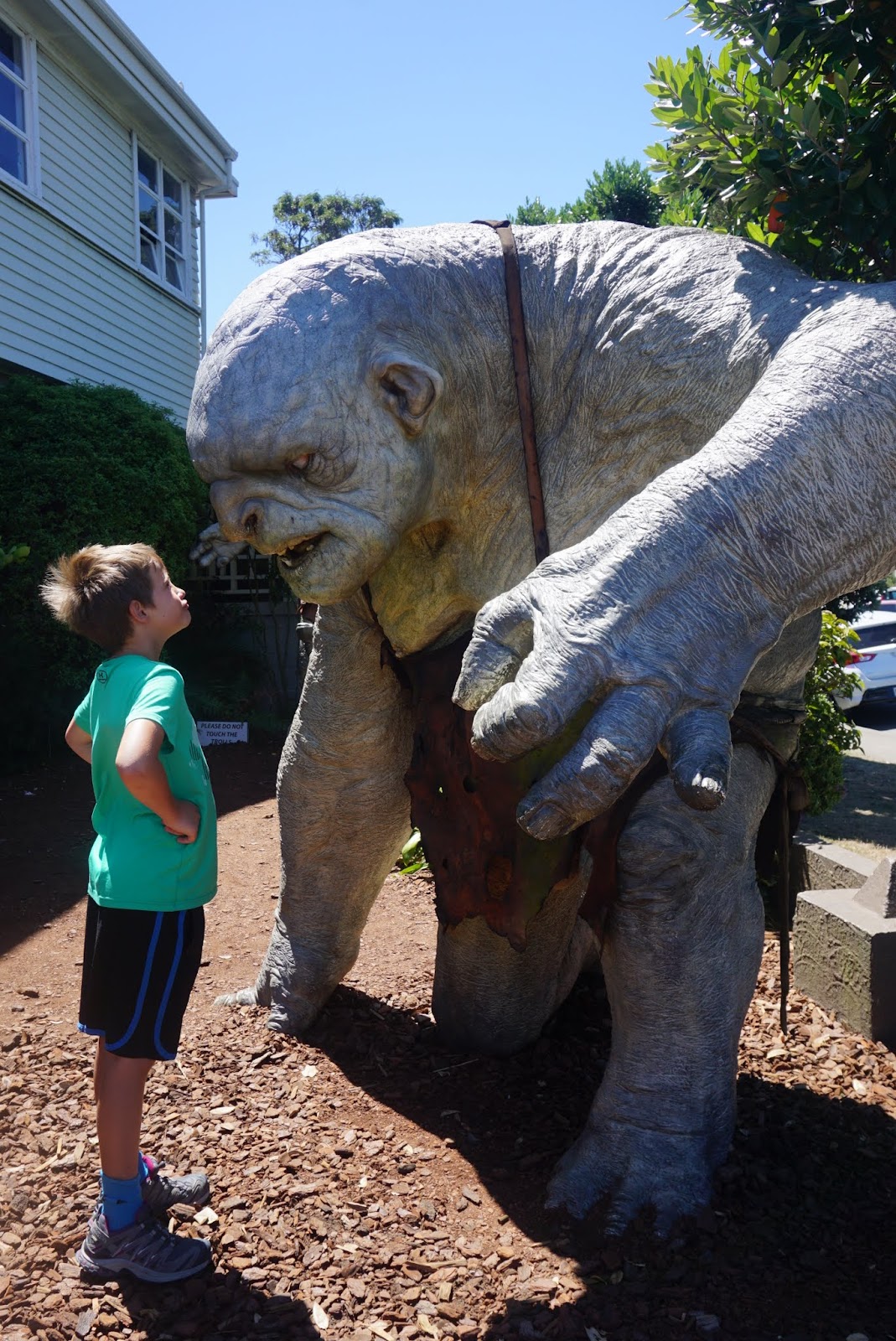
After a beautiful ferry trip through the Cook Straight (the boys watched “Heart of the Sea” on the journey and said it felt like 4D with the rocking) we made it to the bustling New Zealand capital of Wellington. After so long on the South Island, being surrounded by more people than sheep was a bit of a shock.  We toured the Weta Workshop, of Peter Jackson and Lord of the Rings fame, and were amazed at the detail that goes into developing movie props.  We also toured the set of the “Thunderbirds are Go” (unknown cartoon in the US but really popular in the UK/NZ) that contained intricate “maxitures” (big miniatures) that on closer inspection were comprised of everything from repurposed vacuum parts to computer motherboards.  The next day we went to the incredible Te Pa Pa museum and saw the WWI exhibit on Gallipoli.  The exhibit contained several larger than life “sculptures” created by the weta workshop of soldiers that looked like they could step off their platforms—all the way down to the scrapes on their knees and hair on their hands.  It was unbelievable. One sculpture was of a soldier that was so sick and exhausted he fell asleep while on watch.  He was going to be executed for dereliction of duty but was pardoned at the last minute—only to die in the campaign a few days later.    Even more poignant than the sculptures was learning that New Zealand experienced a 93% casualty (killed or injured) rate at Gallipoli.  Even Liam commented that the exhibit “is powerful.”
At the Shire
Next it was up through trout/volcano country to the waitomo region where we had the pleasure of staying with the first of several Rotary hosts.  After several long travel days, being greeted by a new friend and a wonderful home cooked meal was heaven.  I even had the opportunity to play piano duets with our host Laurel.  The next day we went on a “black water rafting” adventure through the Waitomo glowworm caves—also a trip highlight.  Floating down the pitch black cave in inner tubes gazing up at the constellations of thousands of glowworms while listing to our guide singing Maori songs was enchanting—until he smacked the water and shouted “moo” and scared us all to death (sometimes cows fall into the caves).  Next it was off to Hobbiton- the shire movie set, which was incredibly commercialized (hats off to the farmer) but still exceedingly charming.  We watched all of the “LOTR” movies while in New Zealand, and it was fun to walk in the footsteps of Bilbo, Frodo and Gandalf at Bag End.

Hot Water Beach
We spent the next several days in the “bach” (i.e., holiday home, pronounced like “batch”) of Rotarians Rob and Robbie on a lake outside of the geothermal “hotspot” of Rotarua.  We got the chance to meet Rob and Robbie in Auckland and loved hearing about their exploits from around the world including Lake Powell and other adventures.  The kids went zorbing (rolled down the hill in a giant gerbil ball- see video), swam in hot springs, attended a Maori huka feast where the boys learned how to perform a haka (see video) and went mountain bike riding through a redwood forest.  Liam’s highlight was kayaking across the lake in a tiny “weenie wave” kayak that Xander was too big for.  I don’t know what he enjoyed more—the independence, or the name of the kayak.  My highlight was that he didn’t capsize.

Next we headed up to Kae and Ivan’s beach house in Whitianga on the Coromandel Peninsula on the far NE of the North Island.  The best thing about the beach house was that Ivan and Kae came with us.  We loved hanging out with them as they helped us to discover their piece of paradise on the runabout (which we found out was a boat) that Ivan intrepidly let Liam and Xander drive and going on “tiki tours”  around the area to places like Hot Water Beach where we could dig into the sand and create our very own geothermal pool, introducing the kids to their first boogie board experiences and bringing us to a yummy ice cream shop that had servings so big liam couldn’t even finish (although Xander did).  Plus they taught us kiwi slang like “sweet as, bro” (awesome), “pack a sad” (be grumpy), “wot wots” (in the boonies) and “sparrows fart” (really early).  Finally, we made our way to Auckland, where we were generously hosted with Steph and Murray, who let the kids loose on their grandkids legos, showed us around the gorgeous north shore and took us to Muriwai to see the incredible onshore gannet colony on the west coast.

New Zealand couldn’t have been more “sweet as, bro”-- the scenery and adventure were only outdone by the friendly kiwis and their extrondinary hospitality.  Climbing mountains and swimming with dolphins will be experiences the kids will hopefully remember, but more importantly I hope they will internalize how the kindness of strangers transformed them into friends.

Senses
Xander: The truly dusky Dusky dolphins circling around me in the hazy seawater off the coast in kiakura; The sense of gloom and dread washing over me as we learn about the battle for Gallipoli in WWI that cost 93% of New Zealand’s troops; the greenish clear water quickly rising as the dam lets loose a torrent of water to crash over the highest of the rocks into the lower river of the aratiatia rapids in Taupo; the pitch black cave brightening as we get closer to another amazing view of the lush humid gorge through the old mine tunnel window; the glass-like water sparkling as I get pulled and pushed by endless waves into cathedral cove

Carolyn: The big round eyes of the seal pup shining up at us as it clumsily makes its way down the forest river back to the ocean; The shocking sight of the huge, muscular eel  dragged up from the depths with the crayfish pot on our fishing charter wiggling across the deck before making its way back out to sea through a hole in the boat stern; The sound of the Maori chant reverberating off the cave walls as we float silently down the black water river in inner tube gazing at the sparkling constellations of glowworms far above on the cave ceilings; The hair blowing and sweat glistening on the larger than life soldiers in the WWI exhibit, personalizing the grit, heat and futility of Gallipoli; The squawks and caws of the hundreds of gannets on the Muriwai colony as they stretch and flap their wings getting up the gumption to soar off the cliff.

Liam: the hundreds of seals spread about the Rocks doing their daily sealy business as I stand above them to watch; the wriggling and slapping of the prawn as I slowly pull it out of the hot geothermal prawn pond for the only victorious catch of the day at the Huka Prawn park; the old concrete military barracks, tunnels and windows painting a picture in my mind of a refuge city for the zombie apocalypse; the golden rays of sunshine poking out of the clouds creating a golden hue on the still ocean water above the small picturesque mercury bay islands

Jim: My snorkel muffled screeches turning to laughter as a group of five dolphins swim right under me to investigate; the industrial grey spaceship of the evil Hood set from Thunderbirds are Go put together from bits and parts of computers, water bottles, model frames and other "junk"; our philosopher guide instructing me to jump backwards off the first waterfall and following his instructions to result in a refreshing splash under a constellation of glowworms in the waitomo cave; the delicious taste of expresso coffee in the wonderfully relaxing bach overlooking the crystal blue waters of Lake Okareka

Monday, February 1, 2016

Milford Track: Rain, Waterfalls and New Friends

It's not the mountain we conquer, but ourselves
- Sir Edmund Hillary (Kiwi mountaineer & first climber to reach the summit of Everest ) 


The Milford Track across the fjordlands in Southern New Zealand is billed as “the finest walk in the world.”  (Although I’m not sure I would call a 4 day, 53.5km (33.2 mile) trek a “walk”).  Jim booked the trek almost a year ago- almost immediately after we bought our around the world tickets- to reserve us spaces as “independent hikers” at the 40-person Department of Conservation huts along the track.  The other alternative was to book a guided walk, that provided food and showers and cost over 10 times as much (NZ$150 vs. $2000).  The kids don’t even take showers anyway, so it was an easy choice.
Milford Track profile

We're off!
Honestly, I had a fair amount of apprehension about the trek.  I'm all for great scenery, but 3 days walking 10+ miles/6+ hours, with one day over a 1000m (3300ft) elevation change pass with a pack is pretty intimidating.  We also had some uneasiness about Liam.  10 is the minimum age for the hike (Liam is 10).  He’s a great hiker, but doesn’t always want to hike. Being with Liam when he doesn't want to be doing what he's doing is like getting your soul sucked out of you while being crushed by a boulder.  Oh, and the weather forecast a few weeks before showed freezing temperatures and 70kph (45mph) winds on the pass.  Yikes.

As the hike start date came closer, the weather report showed warmer temperatures, but lots and lots of rain.  When we showed up at the Department of Conservation station at Te Anau on Saturday to pick up our tickets for Monday they told us that they flown some people out by helicopter, and weren't sure if the trip was going to be canceled for future days.  The pass was getting 100mm (~4inches of rain) every 6 hours for 2 days (!) but things were looking better by Tuesday.  On Sunday, the DOC still wasn’t sure about Monday, but said that it would be possible that parts of the trail would be flooded up to our waist. The DOC had a discussion to see if we should even attempt it with a 10 year old (umm, what about a wimpy 43 year old?) and ultimately said that it was up to us based on if we thought he could handle it- Liam said walking through a river would make walking that far “fun and less boring”.

Sunday we forged ahead and picked up our rented sleeping bags, cooking pot and trekking poles.  We decided to get rain pants as well.  Jim and his masterful packing skills got everything into 2 big packs and a  day pack.  The packs were heavy, but at least they’d get lighter as we ate the food, and Liam wouldn’t have to carry anything.

Giving up on keeping the shoes dry
Monday morning we arrived at the DOC office to find out the trip was on!  We took the ferry about 1.5 hours to top the of Lake Te Anau and we were off. The first day is only 5k (1.5 hours).  It was pouring, but it is the rainforest after all.  We set off with a good attitude and a new love for rain pants.  One advantage of rain is it creates a continued maze of waterfalls that appear on every mountainside.    We crossed swing bridges and sloshed through the trail that was a toddler’s huge puddle-filled dream surrounded by mossy trees along a rushing river.  When the path turned into a river about 8 inches deep we gave up on the illusion of trying to keep our feet dry and plunged in literately and figuratively  Onward.

We arrived at the first hut early (before 2:00) and fairly soaked.  The 20 bed bunkroom was comfortable and we were able to sit in the cooking area by the fire.  We were regretting that we didn’t bring flip-flops, but a few sprints in the rain between buildings in wet shoes made us appreciate we weren’t in a tent.  We spent the afternoon learning how to play the card game 500 with a nice Australian couple from Melbourne.  Later in the afternoon, the group from the 2nd ferry descended, including a group of 18 Koreans who swooped in draped all of their wet clothes everywhere and started to efficiently make an impressively complicated and pungent meal (we had sandwiches).  Also in the group was a family of 5 from Western Australia with 3 kids (boys 16, 14 and a girl, almost 11).  Hallelujah. One of the trekkers was a ~70ish year old woman who was doing the trek for the 4th time.   She’s Swiss, of course.  We also met several Israelis who were traveling after getting out of the army. The evening was spent making new friends and listening to the ranger talk about the flora and fauna of the area.  The ranger was impressed that Liam knew why the flowers in the region are white (they are pollinated by moths who have an easier time seeing white at night) and the only mammal indigenous to New Zealand (bats).  Homeschool win.

Day 2: 16.5km, (10.3miles)  Early wake up due to the Koreans getting up at 4:30 for a fancy breakfast and 7am departure.  Ah, communal living.  After the deluge of the day before, we welcomed the drizzle.  We walked through the rainforest delighting in the birdsong.  Eagle-eyed Xander even spotted a Kea bird by the orange under its wings.  We would later learn that these “cheeky” alpine parrots would take/destroy any gear that was left outside of the huts—including eating the rubber off of hiking poles and stealing hiking boots (can you imagine?)—so we were instructed to tie our shoes together and hang them up high.  Not a danger I had anticipated.  Eventually, the path opened up to a prairie dwarfed by peaks with cascading waterfalls in all directions.  Around lunch we combined with the Australian family and a charming 29-year-old from South Carolina.  It was great for us all to have other people to talk to and walk with.  Xander carried the pack almost the whole day, including the big uphill at the end.  Hooray.  In the hut we played games with our new friends.  Many of the group (including Xander) were asleep by 6pm.
Day 3: 14km- Touted as the hardest day due to the going up and over the pass and back down 1000m.  Another cloudy (but less wet) morning saw us heading up the mountain-- kids in front, moms in the back.  Three cheers for the hiking poles! After a surprisingly not-so-awful 2 hours walking up, we made it to the top of McKinnon pass, left to imagine what surely are beautiful vistas that were shrouded in clouds.  We stayed long enough to add layers (those extra hats and gloves we bought at the goodwill store earlier int he trip came in really handy) and say hi to the Kea parrot that met us at the top.  We quickly made our way to the shelter, where we entered the "independent hikers" side of the hut, warmed up and shared lunch and hot chocolate (that we made ourselves).  We made Liam peek behind the separate “guided walkers” door-  they had food prepared for them.  We think maybe caviar ;)  The howling winds and sideways drizzle made me leery to head back out for four hours of grueling downhill.
And the clouds part
 However, 15 minutes down, the wind slowed and the clouds parted to reveal the river valley far below—proving (once again) the power of relativity.  The walk down was long and uneven, but gravity is good.  The boys even walked an extra 1.5 hours to visit a huge waterfall (!) and I fought the pressure of “FOMO” (fear of missing out) to enjoy a break basking in the sunshine.   That night we enjoyed our second dehydrated dinner (the Koreans were still making handmade sushi) and fought off sand flies- The bane of the trek, these awful “flying fire ants” cause welts (for some, namely me) that wake you up itching in the middle of the night for days. In Maori legend, when Te-Hine-nui-to-po, goddess of death, visited the spectacular landscape of Milford Sound, she feared the vista was so wonderful that people would want to live there forever. To remind humans of their mortality, she freed namu (sandflies), at Te Namu-a-Te-Hine-nui-te-po (Sandfly Point), at the end of the Milford Track.&nbsp Well played, Te-Hine-nui-to-po, well played.
Swing bridge
Day 4: 18km.  After our last early morning wake up from the Koreans, we had a relatively early start (8am) to hike the last day out to Sandfly point.  Although long, the walk was wonderfully flat and beautiful, with many (more) waterfalls and swaying swing bridges over incredibly clear mountain streams—and lucky for us, most of the water had drained from the previous flooding so we didn’t have to walk through any waist-high streams.   Liam and Xander spent the day walking with the other kids, and Jim and I hung back with the parents.  Liam did not give in to chivalry and carry Alicia’s pack (although she asked) citing her 3 month age advantage as an excuse.  Xander carried our pack the whole last day.  He rocks.  It’s funny to think I spent over 15 hours chatting with Louise—that’s probably more than I get the opportunity to talk with almost all of my friends at home.  We finished up around 2, just in time to catch an early boat and bus back to Te Anau.  Showers and a hot meal never felt/tasted so good. 
Liam says his muscles are bigger.  Xander said he would’ve gone on another trek the next day (as several in the group did.)  My feet have recovered at the cost of some really gross shoes (I’m checking on the REI exchange from abroad policy…) Jim is too nice to say “I told you so.” Our confidence in ourselves and each other is higher, and the hike proved to be a wonderful family accomplishment (and a fine "walk," indeed). 
Milford sound on the boat ride back
Onward and upward (north, in a car, thank goodness).

Wednesday, January 20, 2016

New Zealand South Island Part 1: Meerkats, Beaches and Birds


Our time at home in December passed in a blur of visits with friends and family, enjoying the snow and eating a lot of great meals- which meant we had to buy new pants a size bigger for the second half of the trip;)  We rotated between a host of different friends and family, usually on different nights.  We were happy to have time away from each other, but seeing how incredibly uninterested Xander and Liam were in us when they had the alternative of spending time with their friends made us appreciate the fact that we’ll have them captive for a few more months before losing them to their teens.
Liam and Eli in Abel Tasman National Park
We were all happy to have our first 2nd half destination be New Zealand.  Between the friendly (mostly) easy to understand people, beautiful places, fun activities, and personal safety, there is no easier place to travel (easier than any country we have ever travelled including the USA).  We started with an epic travel day:  Denver à LA à Auckland (13 hours, the longest flight we’ll have)  à Nelson à Collingwood.  We left Monday afternoon and arrived Wed night.  Thanks to crossing the international date line, we skipped December 29th, which happens to be both Mike’s (Jim’s brother) and Jace’s (our nephew’s) birthdays. I’m pretty sure means they didn’t get a year older.  New Zealand is 4 hours behind Denver, but tomorrow. 
The long trip was worth it because we met up with our friends (and Liam’s bestie) from Golden, the Merkerts (aka Meerkats).  It was wonderful to travel with them and their lovely Australian friends Ivan and Chris.  It was also great to have someone else do all the travel planning for a change.  We were some of the first in the world to celebrate the new year on the beach after a day kayaking and hiking in Able Tasman national park (the next day because there was no way were staying up that late).  The next day we discovered the actual natural setting for our Windows 10 screensaver on the beach at Farewell split northern-most point of the Southern Island in (that included baby seals and an exciting hissing-seal encounter.) 
Bringing in the new year on Farewell Spit
After a long rainy day drive down the country, we made our day down to Franz Joseph glacier. Both Jim and I had hiked on the glacier ~20 years ago (and you could as recently as a few years ago), but now it is only accessible via helicopter—really stark evidence of global warming (but still a beautiful hike up to the glacier face).  Another highlight of the area was hiking up through a middle earth-like forest to an old mining tunnel where we waded through water deep underground to see glow worms that made the cave ceiling look like a sky full of constellations. Awesome.
Jetboating on Shotover Canyon
Next we were off via the Wild West coast to Queenstown, the “adventure capital of the world.”   Along the way we saw hector dolphins in the surf, and incredible rock formations.  In Queenstown we rode luges down from the top of the gondola, went jet boating along the Shotover river ½ meter above the river bottom and 2 centimeters from the canyon walls, took a steam boat across stunning lake Wakatipu to see some impressive sheep dogs and sheep shearing, and did a whole lot of wrestling (at least the boys did).  We stayed in Queenstown a few extra days after the Merkerts headed back north that included lots of hikes, a scenic drive to Gandalf country, and a city Segway tour.  Liam ended up crashing his Segway after showboating a bit, but still wants to save up to buy one when he gets home.
Jim training for his future mall cop career
  
On my 10th “surviversary” from cancer, I got to bungee off the Kawaru bridge-  the first commercial bungee jump and my first bungee jump when I was in NZ while in college.  Only now they use harnesses.  (Seriously, the only strap they used to have was to a towel wrapped around your ankles.  Ahh, progress).  The only physical thing that I can do better than Jim and the boys is throw myself off of cliffs.  Luckily, that’s been a fairly significant part of the trip. (Bungee video)
Gandalf country
We’ve spent the last week touring around the far south of New Zealand in the Caitlins where the sheep are plentiful and the trees grow sideways in the wind.  We made it down to Stewart Island and went to Ulva island, a primordial forest where they diligently trap all predators (apparently, rats can swim for 3 days) so that many endangered NZ birds that evolved in a place where there were no predators can live in peace.  A favorite sound has been the two-voice boxed bell bird calls echoing through the forests throughout the South Island.  New Zealand was so isolated for so long it has/had many amazing flora and fauna unique on Earth.  About 500 years ago, New Zealand had the largest bird in the world—the Moa—that was over 3m (~10feet) tall.  It got eaten by the Haast eagle, the largest eagle ever known to have existed.  As with many places, settlement and non-indigenous species have wreaked havoc—for example, rabbits were introduced to keep weeds down, stoats were introduced to keep the rabbit population down-  now there are still a ton of weeds, rabbits, stoats and kiwis are endangered—but New Zealand has had the most visible conservation efforts we’ve seen anywhere to date, and it seems to be making a difference.  
Exploring the Caitlins in the far South
We’re excited to spend another month in this beautiful country.  Our main focus right now is gearing up for the Milford trek, which we start on the 25th.  An ambitious undertaking (for me and Liam at least) but dubbed as one of the “best hikes in the world” it should be amazing (if only it involved cliff jumping). 

Senses:
Jim: The wide beach reflecting the beautiful rock tunnel outcroppings at Farewell Spit; the constellations of glow worms lighting our way through the pitch dark tunnel; the pull of the kite string as I get it to fly to the end of the line, high above the Queenstown hills full of farms, deer and sheep; the refreshing mist from McLean falls filling the air in the dense green forest.

Carolyn: The mellifluous sound of the bell birds calling to each other in the fern covered rainforest on the Abel Tasman waterfall trail; Hector dolphins arching out of the azure Tasman sea wave along the shore of the wild west coast near Haast; the slobber from the ugly-but-cute fluffy scottish bulls tongue coating Xander's hand as he feeds it at the Walter Peak Country farm near Queenstown; the row of trees sticking up from the hectares of sheep fields, twisted and sideways from bracing themselves against the “roaring forties” latitude wind


Liam: The giant waves barely nicking me as I look out to sea to see the small Hector dolphins in the surf; The tortured look on the sheep’s face as it’s thrust to the side and shaved into a tiny naked ball; the inky sap from the mossy moa tree dripping from my stick pen as I write a message on a paper like leaf- the same way people used to send postcard 100 years ago; the plethora of  rocks scattered across gemstone beach as I slowly pick through rock after rock to find the perfect additions to my collection

Xander: The lush green forest filled with beautiful bird songs opening up to a vast hill range of trees and ferns; The turquoise green waves rocking our kayak back and forth and threatening to crash us into the jagged cliffs and rocks of the islands offshore in Able Tasman; Wading through the numbing water of the cave to see glow worms creating constellations across the tunnel ceiling; My face stretching back as we skim centimeters above the bottom of the river and millimeters away from the cliff walls in a jetboat in Shotover canyon; the waterfall shining in the sunlight as it pours down the many tiers of rocks in the Caitlin forest

Lessons learned:
  • Put sunscreen on your feet
  • Kiwis are unique in that they have nostrils at the end of their long beaks.  Since scientists measure beak length from the nostrils, they have one of the smallest beaks of all birds
  • Kiwis are "honorary mammals" because their feathers are similar to fur (they don't have the barbs like other birds) and they don't fly
  • Sandflies are awful
  • Possums are pests in New Zealand.  They were introduced from Australia to try to start a fur trade and are now "plague" proportions.  You see them run over on the road everywhere.  They are protected in Australia.
  • Albatross have a 3m wingspan (as big as the Haast eagle)
  • Tourists love Cadbury chocolate
  • Albatross live on the ocean for 5 years, circumnavigating the world in the southern sea
  • Don't stand up to pee on a rocky boat
  • People on Ulva island wrote postcards on leaves with sap from trees to send back to Scotland
  • Rats can swim for 3 days
  • Kiwi's eggs are the biggest proportion to their body weight-  as big as ostrich eggs. Ouch
  • European settlers came to New Zealand in the 1800 

Monday, December 14, 2015

Argentina and Peru: Mountain Lakes, Glaciers and Old, Stacked Rocks


We arrived in Buenos Aires via Sao Paulo, Brazil after a 10 hour flight across the Pacific.  Gotta love those in-flight entertainment systems.   Although our Spanish is limited, we (especially Jim) had been studying up via the Duo Lingo app and he had luck chatting with the cab driver.  Even if we only can speak in present tense, it was nice to at least be able to sort
of communicate.  Spanish speaking people understood Jim better than many South Africans.

La Recoleta Cemetery
We spent the first few day exploring the vibrant city of Buenos Aires and trying to adjust our schedules to not only the time zone difference, but the lifestyle difference—people in Argentina typically don’t eat dinner until around 9pm and many shops are closed from about 1 to 5 for a mid-afternoon siesta.  Highlights for our time in Buenos Aires included exploring both a natural history and science museum, where we scientifically proved that Xander is now officially taller than Carolyn, a city walking tour that included a gory description of the extensive travels of Eva Peron’s body before she finally ended up in equally spooky and charming La Recoleta cemetery, and a wonderful dinner at new Rotarian friend’s house. 

Planning our time in Argentina was challenging because it is so big—over ten times the area of Colorado (our measuring stick for the size of countries) and relatively difficult/expensive to travel around.  Among the 5+ plus regions that we wanted to visit, each involved a 20+ hour bus ride or multi-hour plane ride that cost $600+ one way (for 4 people), so we had to narrow down our choices.  
Jim's fishing spot
Exploring the river near Bariloche
 We spent a week in ski town of Bariloche in the southern hemisphere spring time hiking, boating and driving around stunning nearby national parks and lakes.  Jim even got to go fly fishing.  He (said he) caught a huge fish right when a tour bus stopped above him on a bridge- although he got applause from the tourists, he didn’t get his own picture.   The water is so clear we could see fish 15 feet below the surface.  Next we flew down to El Calafate in Patagonia.  The 116 degrees between Iceland (66 degrees North) and El Calafate (50 degrees south) is the biggest change in latitude we’ll have on this trip and the furthest South we will be.  El Calafate feels like it is truly in the middle of nowhere on the southern edge of aquamarine Lago Argentino, home to many wild flamingos (!).  Highlights of our time in El Calafate included a boat tour among icebergs, and most of all, the fascinating Perito Merino glacier.  As incredible as the pictures are, the sounds are what make the area seducing - groans and creaks sometimes followed by the tremendous crash of an ice sheets calving into the water.  We also met a French family with 3 kids traveling around South America for a year—on bikes—proving that there’s always someone more intrepid (or crazy) (http://www.ernestastrimbal.com/).
 
Perito Merino glacier

Along with the incredible scenery we learned about some of the fascinating economics, politics and history of Argentina.  Although we had heard about it before we arrived, it was still shocking to learn about the “blue market” (black sounds too ominous) for changing money in Argentina.  If you use a credit card or ATM, the exchange rate is about 9 pesos per USD, while if you change cash on the street, the exchange rate is about 15 pesos per USD.  Basically, we “saved” over $1000 by changing the approximately $1500 in cash we had on the blue market-  with the added bonus of Jim getting the exciting experience of being led into the back office for “cambio.”  When the boys and I heard some loud voices coming from the backroom (Jim insisted on looking at each bill) brave Xander squared his shoulders, took advantage of his new lower voice and asked if Jim “needed any help back there.”  Basically, inflation is currently (and historically has been) so high (for example, over 30% last year) that Argentinians have to deal with the reality that any pesos they earn and save are worth less and less.  (Want that $500 ipad?  Saving for a year?  Now it costs $650)  To protect their money, Argentinians prefer the more stable US dollars, but these are extremely difficult to get—add this to an exchange rate kept artificially low by the government, and you get the blue market.  Crazy.


Another amazing thing we learned about in Argentina was the Association Madres de Plaza de Mayo, a group of mothers who marched in front of the Casa Rosada (Pink House of Evita fame) in Buenos Aires to try to learn what happened to their children who were “disappeared” during the Dirty War of the military dictatorship in the mid 70s to mid 80s.  The plaza is circled by paintings on the ground of the white kerchiefs the mothers wore on their heads (the kerchiefs white cloth represented their children’s diapers) when they marched in silent defiance of the government state’s terrorism intended to silence all opposition.  The related “Grandmothers of the disappeared” have found over 100 children born to mothers who were imprisoned and killed during the Dirty War and subsequently illegally adopted.  These children have largely been found due to DNA testing.  Amazing lesson in history that occurred during our lifetimes and a real world application of Liam’s desire to be a genetic scientist when he grows up. 


We truly enjoyed our time in Argentina learning about its history, seeing some beautiful sights and filling our bellies with empanadas, yerba mate, steaks, and wine.

Next we headed to  Lima, Peru.  We explored some pre-Incan ruins in the city before heading to Cusco (the “belly button of the world” and center of the Incan empire).  We had planned to go Puno to see the reed islands, but got waylaid big time by altitude sickness (see previous post).  Once we get over the trauma of the two kids in the hospital at once we can joke that the whole thing was a kid conspiracy to avoid the long bus rides we had scheduled. We were thrilled to meet Tracey (Carolyn’s sister) and Scott in Cusco.  We had a nice afternoon walking (slowly) through the city and marveling at the astounding Incan architecture and puzzle-like palace walls that have withstood earthquakes that reduced the Spanish churches built on top of them to rubble.


The next day we toured the Sacred Valley where we visited Ollantaytambo and Pisac ruins from the Incan empire and learn about the amazing architecture that is designed to shine beams of sun on the temple throne on solstice days.  It’s mind boggling to imagine how Incans transported and fit together the huge stones without wheels or mortar.  On the way back we stopped to get cuy (aka guinea pig), a common Peruivan food, from a stand at the side of the road.  Liam said it “tastes like chicken.”


No trip to Peru is complete without seeing Machu Picchu, so we took the train to Aguas Callientes, the base town for Machu Picchu. Machu Picchu, although way more touristy than when Jim and I visited via the Inca Trail over 15 years ago, still maintains its mysticism and magic.  The Spanish never found the site- which isn’t surprising considering it took a 4 hour train ride from Cusco and a 30 minute drive up gasp-inspiring hairpin turns to get there.  We agreed with the “worldwide internet poll” that named it one of the “New Seven Wonders of the World” (along with the Coliseum and Great Wall of China).   
By far the best part of the day was when Scott proposed to Tracey on a secluded terrace overlooking the ruins and the mountains!  Definitely worth a jump for joy J Scott had told us about his plan to propose back before we left in July, so we were excited to finally get to see the plan play out and happy for Scott to be able to let his backpack out of his sight once he gave the ring to T.  Hooray! 

To make the most of our stay the next day we hiked up Machu Picchu Mountain.  The original plan was to hike up Huanynu Picchu (the mountain behind the ruins in all of the pictures) but now they only have limited tickets per day that we didn’t get soon enough.  Machu Picchu Mountain is on the other side, and somewhat to our surprise, quite a bit harder/higher, but ultimately worth the 2 hours walking up steps for a stunning view of the ruins peeking out from the drifting clouds.  The kids also got the chance to prove that they were over their altitude sickness, as they easily beat up to the top of the ~3000m (10,000 foot) peak.  No rest for the weary in this crew (sorry Scott!).


We got to visit a few more Inca ruin sites full of “old stacked rocks” before heading back to a long layover in Lima, a stop in Houston (where we almost missed our plane due to some customs issues over the ostrich egg souvenir we carried since South Africa) and finally home to Colorado.  The 10 degree (Fahrenheit) temperatures were a bit of a shock to our follow-the-summer, wear shorts every day bodies, but more than worth it to see family and friends!


We’re enjoying catching up with everyone, drinking tap water, and speaking English.  It’s nice to know where we’re going, and be comfortable with what we’re doing for a change (and oh, the amazing grocery stores) —but we can’t wait to get back on the road to New Zealand right after Christmas.

It’s hard to believe we’ve already completed the first half of our trip-- A wonderful experience for the family where we have all learned a lot about the world, the joy of living light, and how to adapt to whatever happens.

Senses:
Carolyn-  The glisten of the rain on the streets of elaborate tombs in La Recoleta cemetery while I peek into the dingy windows that reveal staircases descending into the spooky abyss; The little brown bird hopping through the brush chirping while we walk through the Bariloche Chicco Circuit forest dwarfed by towering  cinnamon colored Arranayn "bushes" and their smooth peeling bark; The swirling shadow circles dancing gracefully on the bottom of the river bed, created from mini whirlpools on the clear surface of the turquoise river; Listening to  crack and groan of the seemingly alive peaks and valleys of the Perito Merino glacier, waiting to hear the thunderous sound indicating a new iceberg plummeting into the aqua lake below; Happy tears wetting my eyes as I witness Scott propose to T on the terrace overlooking the stunning ruins and surrounding magical mountains of Machu Picchu.

Jim- The stark differences from crypt to crypt in design, quality and upkeep in the Recoleta cemetery; The bitter earthy taste of mate savored through my silver mate sieve straw; the wonderful taste of sweet breads and coffee to fuel the day walking around the city and learning more about the history of Argentina; The sharp tooth-like peaks edging out above the snow and glacier-capped Andes mountains over the town of Bariloche; The cooked brown skin of the cuy sizzling around the spit confirming without a doubt I was not hungry for Guinea pig.

Liam- The pitter patter of the rain falling on my umbrella as we walk through the maze like streets of Buenos Aires looking at somewhat old historical buildings and learning about the complex government and money of Argentina; The elaborate twists and turns of the treelike red and orange "bushes" that grow nowhere else in the world stretching out creating a vast canopy above me; The cold ice cup freezing my lips and mouth as I took gulp after gulp of fanta, sprite and lemonade at the unlimited drinks ice bar inside the glaciarium; The hoard of teenage girls swarming around me d snapping multiple photos of my beautiful face as I stand there frozen in horrified shock; The waitress coming out with a computer-sized metal platter heaped with all different types of sausage, chicken and mystery meats as Scott and I stare in awe at what we ordered for dinner

Xander- The familiar numbing of snow I grab from a snow patch at the top of  a dusty, almost vertical hill as I look down on a sky blue lake and matching cloudless sky above Bariloche; The aqua blue water reflecting snowcapped mountain peaks and revealing a school of trout many feet below; The cool wind rushing across my face as I stare mesmerized by the vast andes mountain range as I ride the boat in the turquoise lake near bariloche; The rough sand paper texture of the pumice rock as I grabbed it while it floated down the small creek leading to the esperco chico (mirror lake); The intricate smooth grey puzzle-like Incan stones overshadowing  the Spanish colonial church built above them

Lessons Learned:
  • Argentinians drink mate (tea) out of sieve straws everywhere
  • There are lots of stray dogs wandering around in Argentina
  • Good Argentinian steak is cheaper than a bag of pretzels
  • Arranyan trees are really bushes and are only found near Bariloche
  • Eva Peron's body had a long and sordid journey after her death, including being embalmed and displayed, being stored in a basement, a government officials office, and in a septic tank and being transported to Spain
  • In Argentina, you can change your family, you can change your religion, but you can never change your futbol team
  • Argentina has a lot (potentially the most) dinosaur bones
  • Buenos Aires architecture is a  juxtaposition of mismatched styles
  • In Bariloche a "small trout" is 18 inches
  • Most of the world's glaciers are in Antarctica; Africa is the continent with the least amount of glaciers
  • What's the difference between snow and glaciers?  Density.
  • Glaciers appear blue because blue wavelength light travels the farthest
  • The Earth’s “snow zone” is about 35degrees N and S in latitude, although higher elevations may have snow
  • In Argentinian grocery stores, milk (and many other liquid substances) come in bags, the stores don't have any bags to put your purchases into and eggs come in pallets of 30.  If you ask for fewer eggs, they tell you to put them in a bag (!)
  • Many stores in Argentina are closed from around 1 to 5 pm, and aren't open on Sundays
  • The tourist ticket (aka “tourist tax”) is typically at least double the local entrance fee
  • There is always someone more adventurous than you, and there's always a way to do things more luxuriously or cheaply
  • Pass on good travel karma
  • If you want to buy something, get it the first time you see it because you probably won't go back
  • Travel insurance is worth it
  • If your kids end up in the hospital, you really slack off on recording lessons learned
  • It's great to be home, but even better to know you're going back out


Saturday, November 21, 2015

Monster under the bed

trooper
Not surprisingly, our posts usually focus on the trip highlights and happy moments.  Even during the “down” times-- the stress of getting to a new place and trying to figure things out, the long boring transport days, sniping at each other because we’re “hangry” and/or have been within arm’s reach of each other for a week—it’s all pretty much part of the adventure.  But getting sick so far away from home when we can’t speak the language and the medical facilities are a different standard (if there are any to be found) is the monster under the bed that we don’t want to think about and are most afraid of. We’ve had a few issues- including some painful/messy traveler’s stomach, random allergic reactions that necessitated the quick administration of Benadryl, a course of antibiotics for both kids to kick lingering coughs, and a mysterious circle on Xander’s thigh that we thought was a bug bite but was apparently a fungus.  Although not pleasant (ok, some of the stomach stuff has been downright miserable) these ailments have been short-lived and somewhat predictable (maybe not the circle fungus)-- but we never would have predicted what happened this past week.

bionic man
We arrived in Cusco, Peru (elevation 11,400 feet) on Sunday.  We had a nice day walking around the city on Monday and all was well.  Monday evening Xander went to bed with a headache. Both kids were coughing through the night.  By Tuesday morning, both kids were coughing a ton and Xander was wheezing a lot.  He’s had some asthma in the past, so we treated him with the albuterol and steroid inhalers that typically alleviate his symptoms. Liam was uncomfortable and threw up.  By about 10am we took a taxi to the hospital. Before we left, Xander was pretty much passed out on the bed, shockingly pale, breathing incredibly fast and shallow.  I had to carry Liam on my back down the three flights of stairs from our apartment to the street because he was so weak.  They just both went downhill so quickly.


When we got to the clinic, they rushed them both back into the emergency room.  Liam threw up again all over everything.  Xander’s pulse ox was under 70 and his lips were turning blue.  They immediately put him on a high flow of oxygen and gave him an IV.  They took Liam and me to a different room and put him oxygen and gave him an IV. The nurse had a really hard time finding his vein.  He was very brave with the multiple needle pokes. Chest x-rays of both kids showed fluid in their lungs—high altitude pulmonary edema.  A rare and very dangerous form of altitude sickness.

Altitude sickness?  These Colorado born and bred kids that spend every other weekend in Winter Park?   Unimaginable.  Both kids in the hospital at the same time?  Inconceivable.

bundled up for a transfer
Xander had to go to a different hospital because he had to go into the ICU.  His heart and breathing rate were so high, they were worried that his diaphragm would stop working.  I stayed with Liam and Jim went with Xander.  Jim and I alternated at the different hospitals.  We could text each other, thank goodness.  Any elementary Spanish I know was lost in the fog of sleeplessne
ss and worry.    I could ask “What is happening?” but not really understand the answer.  I made the mistake of looking up pulmonary edema on the internet. I have never felt so incompetent or as horrible a parent.  Liam broke my heart by crying for the first time only when I told him we probably wouldn’t get to go to Machu Picchu.  Through all of this the kids still want to continue our adventure. 

Hyperbaric chamber
Along with oxygen, IV steroids, diuretics and antibotics for Xander (to fight pneumonia) both kids got several treatments in a hyperbaric chamber.  For some reason they didn’t take either of them to the chamber until about 9pm, which was really exhausting.  Liam couldn’t hear anything in the chamber so I typed things into my phone and held it up to the glass.  He’d write back with his finger on the steam on the inside of the glass.  The second day he wanted to bring in his tablet but they wouldn’t let him because it could spark inside the chamber and make it explode (high oxygen and pressure).  Xander had to go to a different hospital in an ambulance to his chamber.  Riding in an ambulance late at night on the streets in Cusco is not an experience I would recommend to even the most intrepid.

There are five clinics in Cusco that treat high altitude sickness—just the fact that there are multiple hyperbaric chambers within a few kilometer radius is telling.  The kids received good care, since they’re on the road to better.  One of the main differences between hospitals in Cusco and at home seemed to be the electronics.  For example, the IV was gravity fed, the head of the bed went up with a crank, and the xrays were printed on film.  This also had the advantage of being a lot quieter—for example, no jarring beeping when an IV ran out, and they didn’t come in and check every few hours through the night.  Jim and I slept in the extra bed in their hospital rooms.  In the ICU, they gave us a separate room in the hospital in which to sleep. I guess electronics (or US healthcare) come at a much higher cost.  All of Liam’s treatment and two nights at the hospital cost about $2000, Xander’s treatment and two days in ICU and one day at the clinic cost about $3000.  It would have cost at least 10 times that in the US. We paid $250/kid with our travel insurance.   So there’s that.


They are both doing ok.  Xander, not surprisingly, is wiped and queasy from the antibotics. One of the primary treatments for high altitude sickness is to go to a lower altitude, but we flew here, and Lima is a 20+ hour bus ride away.  There was a lot of uncertainty about where and when we could go places.  Additionally, it was a lot of effort to unravel the plans we had already put in place.  We are currently in Urubamba, in the Sacred Valley, which is about 2000 feet lower than Cusco.  Luckily, Machu Picchu is even lower (about 7500 feet) so we will be able to go there.  My sister Tracey and Scott are currently on their way to Cusco and we can’t wait to see them tomorrow!
Sacred Valley- brighter days ahead


We decided to come home a week early and will be back next Friday for a few weeks.  The kids want to go to Mesa Verde with our “free” week because they said it would be interesting to compare the two ruins.   They also said they want our next family trip to be in Peru so we can do the travel we’re skipping this time around.  They are troopers.  As for me, I’m still a bit shell shocked.  I cannot put into words how frightening this experience was.  I so do not want to it to tarnish this trip or our love of travel.  I want to focus on what we’re doing for them instead of what we’re doing to them. 

One of our school things is to work on spelling and vocabulary.  One of Xander’s words last week was “resilient” (the only reason I just spelled that word right is because I practiced it with him.)  Probably when we go home they’ll boast about going in a hyperbaric oxygen chamber as much as riding an ostrich. Hopefully I can live up to the kids’ example.